Showing posts with label Classic Play. Show all posts

Friday, January 28, 2011

Running a Science Fiction Campaign

Oooh!  My favorite subject!

Running a Science Fiction campaign can be really fun if you find the right combination for you and your players.  Since I'm all about freedom, my favorites are basically Space Opera games.  My favorite setting of the whole bunch is Selling the Moon, Wholesale! with possibly a military campaign set during the Long Night (see Gene Rodinberry's Andromeda for an example) running second and an Exploration game running third (Star Trek, Buck Rogers).

I want to talk about Selling the Moon, Wholesale setup first.  This campaign offers the best freedom for you and your players in my mind.  There are a huge amount of media that represents this setting, and most of them are computer games.

The best known examples of this type of campaign that come to my mind include Wing Commander: Privateer, Microsoft's Freelancer, and Elite.

Wing Commander: Privateer

Wing Commander: Privateer is the successor of the game Elite. It's probably the best example of what to do in a campaign setting such as this.  Privateer  allows the player to really play in an expansive universe that immerses you in an expansive universe (although its only relegated to the Gemini Sector -- a sector built around the Gemini constellation in the Zodiac).   There is essentially three paths opened to you: you can be a free trader, a mercenary, or a smuggler.  What is best about the game is it's openness.


What does Selling the Moon, Wholesale offer you and your players?

Using Wing Commander: Privateer as a model, this model offers both the GM and the Players Dungeons and Dragons styled like scripting and running.  The game is made up of three separate elements that ensure player freedom.  They include:

* Random Encounters among space lanes.
* Small missions brokered by Independents, the Mercenaries Guild and the Merchants Guild
* Fixer missions.

Random Encounters

Although not in vogue among the RPGA, a Random Encounter system is great for Selling the Moon Wholesale because you can use Random encounters to set up your players with a bit of randomess against any NPC factions you have working in your universe.  Like pirates, retroes, or enemy Space Nations (like the Kilrathi [space cats] or the Magog [space orcs] for example).

 Small Missions

Small missions are GM created missions that usually don't need anything beyond an objective and random encounters.  They can be written down on 3x5 cards with stats for spaceships and who is flying them.  They can also include generated star systems for planets or drifts you can visit.  Small missions are brokered by organizations through your Merchants Guild, your Mercenary's Guild, or a concourse kiosk.

Fixer Missions

Fixer Missions are full blown adventures -- written by you or published.  They are brokered by NPCs, and provide you with a true plot and campaign scripting within your universe.  Some examples are the old SpaceMaster Modules from ICE or the old modules from Star Frontiers.  Even Gamma World modules may work with some rewriting.  The Old Privateer game had a main campaign, find out how to destroy the egg that has been plaguing shipping lanes.  While this strung people along, as a GM you don't have to string your players along in a campaign such as this.


Choosing your Game System

The Choice of a Game System is pretty important when running a game.  You need a good game system that will provide fun for you and your players.  Published game systems include:

  1. Traveler
  2. SpaceMaster: Privateers
  3. Star Trek: The Next Generation Roleplaying Game
  4. Star Wars Saga
  5. GURPS
  6. Star Frontiers
  7. Alternity
  8. d20 Future
  9. Big Eyes, Small Mouth 
  10. BESM d20
Of the games above, I tend to make a mishmash.  I use GURPS: Space and LUG's Star Trek: The Next Generation Roleplaying Game for my Gamemaster advice, and SpaceMaster: Privateers as my system of choice.  The latter is crunchy enough to handle both Space Opera and Hard SF settings.   While the earlier provides some Good Advice!  The old LUG Trek game has the best advice on making system settings (called sectors), while GURPS Space provides some good all around advice.

That is just my set up, you can use whatever game you enjoy for you and your players.

Choice of Setting

So what is left is choosing a setting.  From Star Trek to Privateer to Andromeda to Blue Planet there are a lot of published settings you can use.  Even Space 1899 and Space 1999 are not impossible!  Lets use Privateer as an example.

The game starts you out in the Gemini Sector, in the Troy system.  The Troy system has a terraformed planet (Troy 3, I think -- known as Helen), and two Mining Bases (Hector and Achilles) with jump points to the Pollux, War, Regallis, Pender's Star, and Pyrannees systems.

you allow the players to either create their own ship, or give them a Taurus scout ship (note, if they create their own Hyperyacht, do not give them starting money!).   You also can start them on Helen (which is a Garden planet) or one of the mining bases.


On a base in Privateer, the players have access to the concourse -- which provides offices to the Mercenaries Guild, the Merchant's Guild, a ship dealer, a commodity exchange, a bar, and a mission kiosk.  As GM, on certain bases, you can expand the concourse to include a mini mall in which players an buy new clothes and food for their ship (maybe even get a food replicator).

The mission kiosk is where you can dispense your "mini" missions, and the Commodity Exchange is where the players can buy commodities to buy and sell on the open (and black) markets.
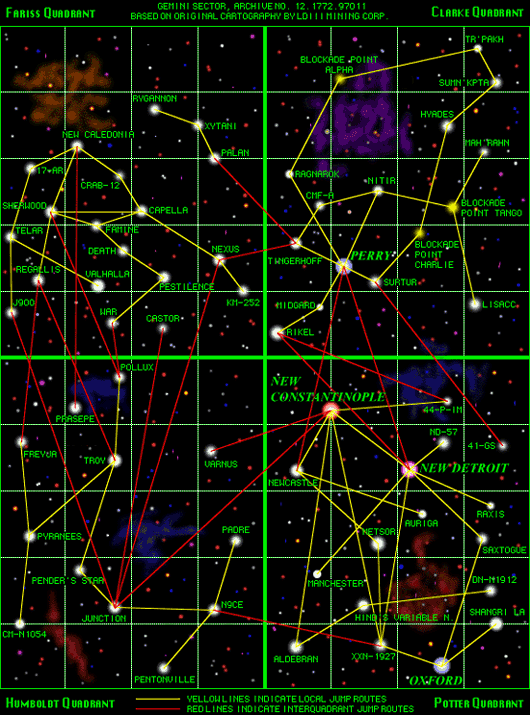
There are some interesting things about the Privateer universe.  There are a couple of base types the players can fly too:
  • Agriculture planets
  • Mining Bases
  • Refinery bases
  • Pleasure Planets
  • Pirate bases
  • New Constantinople (the Capitol)
  • Perry (Military Base)
  • New Detroit (Refinery and Manufacturing center)
  • Oxford (University planet)
And there are factions.
  • Militia -- citizen Space police.
  • Confed -- Galactic Confederation Military (Earth controlled, of course)
  • Retros -- The Church of Man, a bunch of religious fanatics that want to take away your electric razor.
  • Pirates -- yes, you know who these are.
  • Bounty hunters -- the Competition in the Mercenary market, these citizens are space Vigilantes.
  • Merchants -- Your competition in the Merchant market
  • The Kilrathi -- Humanoid cats which are more like D&D Hobgoblins with their own politics and agenda.  Do not think of them as orcs . . . that's for the Magog.  The Confederation is at war with the Kilrathi.


Plus there are a bunch of NPCs you can lift from the game.  


There is a lot you can do, and I hope I gave you a lot of good ideas.  If you enjoy science fiction gaming, the sky is literally the limit since there is a whole goldmine out there just waiting for you to explore!

Sunday, January 9, 2011

The Record of Lodoss War

 
If you really want to see a series that is full of D&Disms, and is quite serious about its subject matter, the High Fantasy Anime Record of Lodoss War is perfect for your appetites.  The series chronicles the adventures of Parn, Deedlit, Etoh, Slayne, Woodchuck, and Ghim as they have misadventure after misadventure brought on by the Island of Marmo and Karla the Grey Witch.

The series itself is directly based on Dungeons and Dragons (BECMI or the real 4th Edition) where there is a Fighter (Parn), Cleric (Etoh), Magic-User (Slayn), Thief (Woodchuck) -- all human of course -- and a High Elf (Deedlit) and a Dwarf (Ghim).  The only character missing is a halfling.  As it happened the Dungeon Master of the original Lodoss War campaign came to America looking for inspiration.  He bought the Dungeons and Dragons game and went back to Japan.

He created the world of Lodoss and set his players on a series of adventures that were recounted in the pages of a Japanese Magazine.  The series takes a lot from the Lord of the Rings (are you really surprised?) as Ghim is actually based on Gimli.  The sad part, for Americans, was that the Campaign Setting was pitched to TSR, Inc. but was rejected.  What was America's loss is Japan's gain actually.  The series Dungeon Master wrote a RPG of his own to publish his world with -- called Sword World RPG.  The series was eventually released in America, though, on DVD as an Anime Series and not as an RPG Campaign (along with the series).  A sad thing, really.  After talking about Classic fantasy, I'm bringing up a High Fantasy world.  Now why would you think that?

The Record of Lodoss War and the Slayers, which will be detailed next, along with other anime set in the Western High Fantasy genre; are the inspiration for the Dynamic Spellcasting System.  Like I said before, the Spellcasting System is designed to replicate what you see in these sorts of Anime (and read in books).

It's a tradition now lost in the D&D RPG, since Wizards redesigned the system to take much of the wonder out.  The Powers System -- which doesn't fit High Fantasy at all -- is more of a fit for the Magical Girl genre of Anime.  Sailor Moon, Card Captor Sakura, and Sakura Wars fit Wizards of the Coast's new incarnation of the game more than Record of Lodoss War and The Slayers now do.  Eh, all in the name of Balance, I guess.

However, the Biggest secret of roleplaying isn't the rules; its the world and then the rules you make up as you go along.  You really don't need D&D to play Adult styled Make-Believe.  Just create a world and play as you go along.  The stuff that Wizards foists on gamers is really unneeded.  There are thousands of RPGs on the Market, and you can always make one up as you go.  The D&D game is just a start -- the idea is to figure out when you're ready to break through and go independent.

Sunday, January 2, 2011

Several Spells of Wonder

I have an idea that could be a good test of the OGL. Copying some spells from the Book, More Magic and Mayhem as wizard spells for use in Pathfinder. The spells are:

Fire Bolt

Shadow Bolt

Fireblast

Combustion

Immolate

Conflagrate

Soulfire

:D

Just a crazy Idea I had.

Wednesday, December 8, 2010

World of Warcraft Adventures Wiki gone live!

I started a new Wiki for the World of Warcraft RPG.  Called Adventures in World of Warcraft I originally thought of doing it up for Quel'thalas campaigns.  However, since the World of Warcraft is ever reaching and encompasses quite a large area, I opening up the Wiki for every World of Warcraft fan to record their adventures for everyone to use.  The spirit of the site is sharing.  Sharing your adventures set in World of Warcraft to everyone.

We will accept adventures written for the RPG, or written for 4th Edition, or for Pathfinder, or for most any system you please.  As long as you mark what system the adventure is for.  Players and fans may write adventures for any era to share with other fans of the pencil-and-paper side of the franchise.

Thanks for reading! :D

Elton.

Sunday, December 5, 2010

The Caves of Chaos


My, my.

Finally we get the PCs up and going for the Caves of Chaos!!  It's finally happening, the PCs (well, 2 of them) are finally ready to go into the Caves of Chaos.  The problem seems to be that Rolemaster PCs at first level are woefully underpowered against their D&D counterparts.  For instance, at 2nd level, an RM magician gets a plasma bolt -- SHOCK BOLT -- it's called (in D&D 4e, it's an at will power called magic missile that clueless idiots get to cast at the Darkness every time they feel like it while their fellow player wants to do some chicks at the local tavern.  Stupid thing should be a DAILY power).  Ahem.

This is Rolemaster, not the cartoonish thingy of 4th Edition.  People get hurt.  People get maimed.  People bleed.  People get their limbs hacked off.  People get hit by Interplanetary bolts of lightning and light up like Christmas Trees.  That sort of thing.  So what is terrible about a D&D dungeon crawl when you rolemasterize it?  They, the players, are facing greater odds.  There aren't five gnolls that fall down every time you zap them, there are five gnolls that can really kill your character -- with experience comparable to level 1 D&D characters.  But there is a reason why the PCs are going into the Caverns of Chaos.

The Drow of the Underdark is infiltrating the government of Evereska.  They killed the Queen and they dumped her body in the Caverns of Chaos.  The elvish government need proof before they can act against the Drow in Evereska.  That proof, the body of the dead queen of Evereska, is in the Caverns of Chaos.  A place most sane people would stay away from.

Even if your players play fourth edition and have gnolls for breakfast. 

Wednesday, November 24, 2010

Obligatory Naked Elves Render

 
In my adventure I'm writing, the Gray Wolf Tribe has contact with mountain wild elves that has totally gone native.  In other words, they are a clan of naked elves.  Why they did it?  No one hopes to fully understand the minds of the elves.

Actually, in truth, the body is good and wonderful and our compulsiveness to cover up the body even though the Son of Man had atoned for us and gotten rid of the effects of the Fall is completely in comprehensive.  The Father meant for his Children to be nudists.

Friday, November 12, 2010

Review of the Eberron Player's Guide


Byline: It still misses that Old Dungeons and Dragons magic.

The Eberron Player's Guide misses that old Dungeons and Dragons magic.  It suffers from the same writing style as the 4th Edition PHB 1, but not nearly so much.  There are several things changed that I don't agree with cannonically. Having the original Eberron Campaign Setting (and still in GOOD CONDITION!) there was some significant changes made to this edition.  Plus, Keith Baker wasn't listed as a writer, so I wonder if he had any input at all.

That being said, I don't think you need the DM's Guide at all if you have the original setting except for the monsters (Karnnathi Zombies, Skeletons, Dolgaunts, and so forth).  You can get most of the changes from the Player's Guide. The first chapter, Life in Eberron explains what Eberron is like today and yesterday.  This chapter introduces you to the basics of the setting. Bringing back some of that old magic.  It goes and explains the world of Eberron.  From Khorvaire and Sarlona; to Aerenal, Argonessen, Xendrik, and Everice.

It then explains the planes and how they work.  what life is like across Khorvaire,  how the governments work, what everyday life is like, how money works, and the languages work.  It's also how naming works.  They also talk about the gods and their alignment, and the other religions and how they work. It also goes into the current age, and the calendar.   Then all the other items of Eberron is presented towards the player's point of view.


The Races chapter goes into the individual races.  From changelings, to Kalashtar, to the Warforged; each of these are presented in the same format you see in PHB 1.  What a tragedy.  But each are described in detail (note, though, the Races of Eberron book for 3e goes into far more detail about these races).  Two of them haven't changed much to their 3e counterparts.  That would be the Warforged and the Changelings.  The Kalashtar, however, had an enormous change.  They are granted the bastion of Mental Clarity power.  They still have inborn telepathy -- but it's treated as a language.  IF you want to play Kalashtar to their greatest effect, buy a copy of PHB3 and the Psionics expansion book.  The only race that isn't presented is the Shifters in this section.  What's wrong, Wizards?  Can't you reprint the Shifters from PHB 2?

Beyond that, they go into the Core races and the not-so-core races and where they fit in Eberron. What is nice is that they tell you where everyone fits.  And the Dragonborn came from -- you guessed it -- Argonessen and are based in Q'Barra.

So, you get into classes and how they fit in Eberron in Classes.  You get dozens of paragon paths, and epic destinies.  You also get some new feats, equipment, and magic items in Character options along with some new rituals.

The five nations are talked about in The Five Nations chapter.  What is common knowledge about them, and how to work in the five nations and how the PCs relate to them. It also talks about Sharn and what is going on in the Mournland (Cyre).  It also talks about what is going on beyond the Five Nations and Beyond Khorvaire from a player's perspective.  Finally it went into a large amount of backgrounds.

Conclusion

Yeah, I bought it for $29.00 (with added tax).   Was it worth $29.00?  Compared to coming Hyper-inflation . . . YES!  ahem . . . in 1910, I could probably get this for 5 cents, maybe 25 cents.  In 2012, this same book will cost you $80.  Sorry, that's the way it is.

Despite this, I think that I could run a 4e game with is, almost.  I have the original ECS, so I can't run out of plots.  Really.  Well, I guess.  Maybe.  No, definitely.  I don't like 4e, but I like this book.  If you want to run Eberron with 4e, this book is needed.  But if you have the original ECS, it's not worth it to spend the extra 10 just for monster stats.  You're best bet is to extrapolate them from the original 3E book.

Wednesday, November 3, 2010

SpaceMaster New Space update

I've begun to post my Spacemaster campaign on the RPGnet wiki.  Called SpaceMaster: New Space, for lack of a better name.  Writing this took most of the day.   Especially for a game inspired by Microsoft Freelancer and Origin's classic Privateer.

The campaign is fairly different from the above two.  It takes place in 1982, with the associated microcomputer in development (2 to 4 bytes per second).  However, some planets have computers that exceed this limit, but hasn't broken Bode's Law.

Items added today:
Scro, Eldar, the Massachusetts System, and Planet Akihabara in the Honshu System.

Monday, October 25, 2010

My Spacemaster Campaign

236084main MilkyWay-full-annotated
By NASA/JPL-Caltech/R. Hurt[see page for license], via Wikimedia Commons; in the Public Domain


It's the Year 1982.

Twenty Years earlier, the Illithids were defeated in a major Interstellar War against the Nations and the Powers of World War Two.  The Allies and the Axis joined together to fight the Illithids.  Using FTL capability given them by the Eldar, the Earthers fought a major campaign to keep their independence and right to live.

The Earthlings defeated the Illithids at the Battle of Orion in 1962, forcing them to withdraw their imperial interests out of the Orion Spur.  The Illithids still have a far reaching empire: in the outer arm, the Perseus Arm, the Norma Arm, and the Scutum-Centaurus Arm of the Milky Way Galaxy.

Mankind has settled the galaxy some forty light years beyond Sol.  Each Nation, except the USSR, formed their own stellar nation and their citizens raced to these new nations to start new lives among the territory that the Earthers conquered from the Illithids.  But the Illithids are still out there, biding their time to plot revenge.

This image of the "Mind flayer" creature (concepted by TSR Inc. and Wizards of the Coast) is a from-scratch fan drawing.

The Illithids were utterly defeated, but there are planets within the Orion Spur where some are still rumored to exist.  The defeat did not come easily, but victory meant that the humans had new worlds to settle that were under Illithid Domination.  And in the far Frontier, skirmishes between Illithids and Earthers are uncommon.


TECHNOLOGY OF THE EARTHERS

The Technology of the Earthers are simple, it's rivets and steel.   While the Illithids use organic hulls on their space ships, the Earthers use strong Fullerine hulls.  While the Eldar use wood, the Scro also depend on metal.

Space Drives

Human Technology depend on a Plasma Ion Propulsion drive for space -- which is similar to a fusion reactor drive, but plasma is used to foster the fusion process and the resultant ions are forced out of the nozzles.  While in air, propulsion is based on a reactionless electromagnetic gravity drive.  The Earther ships are able to produce electromagnetic fields around their ship that causes the ship to counter gravity and lift themselves up.

Humans depend on two star drives: the Plasma Slipstream Drive and the Fold Space Drive.  The Plasma Slipstream Drive creates a Birkland Current around the ship and slips it into Faster Than Light travel.

Plasma Slipstream, in action.  (From Stargate Universe)
The second method of travel is a fold drive.  Carried on the largest of ships (such as space battleships and space carriers) the Fold Drive is a quick way of transporting a large amount of ships to another part of Interstellar Space as quickly as possible. Developed in 1960, the Fold Drive was used to transport five Earther Fleets to the Orion Nebula where they dealt with the Illithid Armada that amassed to conquer the Earthers.  However, the Illithids had trouble of their own and the Earthers had allies: the Scro, the Eldar, the Draconids, and other races in the Galaxy.  They defeated and destroyed the Illithid Armada in the Orion Spur.  Their power broken in the Spur, the Illithids retreated their own holdings in other parts of the Galaxy.

Drive Speed:

The new generation of Plasma Slipstream Drives allows ships to go at 7 parsecs a day.; this pretty much means that a ship traveling from Earth to Alpha Centauri at about 4.5 hours, to Canopus (which is 30 parsecs) about 4 days of travel; and Across the Galactic Arm, which is 2,000 parsecs: about 9 months.  It takes 4 years to reach the Plasma confluence at the Galactic Core -- a distance of 10,000 parsecs.  The Fold Drive system can carry ships up to a maximum of 50 light years per use.  Most people prefer to use the Plasma Slipstream FTL if they can help it.  The first generation Fold System is very temperamental and unreliable.

Fuel

Earther Ships rely on Plasma Fusion Generators to generate ion thrust and electrical power for the ship. However, the Zero Point Energy Converter is still experimental, as it would convert Zero Point Energy into electrical power and propulsion power.  The fuel capacity for Plasma Fusion allows a ship to have a range of 20 parsecs non-stop.

Star Fashion, by myself.


FTL Astrogation

FTL Astrogation is Complex and 3-Dimensional.  The course must take into account the gravitational fields of intervening suns and star drift.  A reliable course (Astrogation, Medium) can only be computed if the Astrogator has complete information about the system.


Communications

The communications of the galaxy depends on FTL communication via a tachyon network.  While frontier planets depends on courier ships; planets closer to Sol uses the Tachyon network.  Courier ships use Fold Systems to get from place to place, though, delivering the news.

Computers and Cybernetics

IN 1982, the Intergrated Circuit is still in its infancy.  Computers have the power of a Apple IIe or a TRS-80 (pronounced trash 80) or an IBM computer with only 128 kilobytes of memory.  Calculations and programming are done by Machine Language (COBOL), C, and Microsoft BASIC.  Spreadsheets and Databases keep the computer banks informed.  However, most ships have mainframes that carry 10 GBs of storage.  Given the computer's level of evolution, however, Energy Matter Teleporation by machine is necessarily impossible.


Gravity Manipulation!

Gravity onboard ship is achieved by using electricity to produce the necessary Gravity aboard ship.  Electricity is 10 to the 39th power much more powerful than gravity.  Conversely, a ship is capable of generating powerful electromagnetic fields to counteract the effects of gravity, in order to lift itself into space.


Next Post: RACES!

Friday, July 23, 2010

Remember Morrowind?


Morrowind was a game that said you can do anything you like.  Even raid sacred tombs for important stuff.  The guide to Morrowind was packed with locations that had all sorts of juicy bits.  Although Morrowind wasn't as BIG as Daggerfall, the game had giving you a lot to do and explore.  A roleplaying game adventure should have these options, although usually page count prevents the writer from including some options.

Each option would be a treasure or an encounter.  I started to do this with my Atlantis adventure, almost absent mindedly.  The PCs would go there, raid a tomb, and have some fun.  Or an option led you to a strange encounter, or some treasure in some unusual places.  (in my Atlantis adventure, I already listed some interesting encounters - a Bronze Dragon and an abandoned pirate's cove).

The idea is to have fun with an adventure or video game.  I'm off to play more morrowind!! :)  And yes, I usually play a Telvanni. :)

Saturday, May 1, 2010

Chapter 2: Character Races

Chapter 2: Character Races for Galatea: the Caithness Isles is mostly complete.  The races you can play include humans, eladrin, high elves, Massalian elves, wood elves, orcs, trolls, dwarves, gnomes, goblins, trolls, and Tieflings.  Do you want to see halflings as well?

The next in the project is going to be Character Classes.  I'll be adding a few new Character Classes to the game from the World of Warcraft Roleplaying Game.  These character classes include the Shaman, the Warlock, the Hunter, the Inscriber, and the Runemaster.

The Shaman is a class that deals with the spirit world of Galatea.  Shamans usually lead tribal people through their spiritual and mythic journeys and use spells that have to deal with spirits and the elements.

The Warlock practices demoniac magic and usually has an evil outsider as a companion.  Some warlocks often fight corruption, while others revel in their corruption.  Warlock magic is an easy gateway to evil.  Although some warlocks prefer to fight fire with fire and not even think about the possibility of corruption.  They use the magic of demons to fight demons.  In the Caithness Isles, the Warlock replaces the summoner class.

The Hunter does not replace the ranger, but acts as a complimentary class.  The hunter specializes in hunting and using animal companions to help him on the hunt.  Hunters are also artillery specialists, often specializing in the bow and arrow and imbuing the bow and arrow with mystical properties and expanding their pets' capabilities.

The Incriber and the Runemaster work with the runes of the world.  The inscriber is more of a traditional spellcaster except they cast their spells through runes, sigils, and glyphs.  The runemaster, however, tattoos his body with the same runes, sigils, and glyphs to increase his offensive power and control.


After that, I'll be talking about how the other classes work in the campaign.


Now working on: CHARACTER CLASSES